
What If?


For the most part, my biography-writing days are over, but when I was digging into the lives of famous people I loved playing the game of What If? Researching a biography can be one long drawn-out game of What If? which is also something like picking the right tarot card.
From discovering all of the twists and turns, possible roads taken — or not — and mapping out cradle-to-sometimes-grave timelines for my subjects, it’s easy to see how the slightest of changes along a life path would mean I’d be writing about somebody else.
For example, what if Rachel Maddow hadn’t won an audition to be a morning-zoo sidekick on WRNX out of Holyoke, Massachusetts in 1999, and became an academic like she had originally planned? Who would you be watching on MSNBC instead? And if Alex Trebek’s childhood friends weren’t able to pull him out of a frozen river when he fell through the ice? Who would have hosted Jeopardy! for all those years?
In my own case, given the umpteen turns along the way for my predecessors, it’s a miracle that I’m here at all. Here, along with some backstory, are my What Ifs?:
My father wanted a family. My mother wanted a life.
In the end, neither one got what they wanted. In the beginning, though, they were happy.
One generation removed from life as a Polish babushka, my mother was a short butterball of a woman, topping out at 5’1” and 150 pounds. She wore loosely-fitting blouses to hide her enormous breasts and draped her bras over a bedroom chair to dry. As a kid, my head fit into one cup with plenty of space left over.
Family lore says that when he was a teenager, her father Myron deserted a chain gang in Poland in his youth and hitched a ride to England, where he stowed away on a ship bound for the United States. When Ellis Island loomed into view, he jumped off the ship and swam to Jersey City. Myron swept sidewalks and pack-muled crates of moldy cabbage to earn a few coins, scrounging meals from garbage cans and sleeping in alleys, and eventually learned enough English to survive.
If he had been deported — or if he had drowned while swimming to Jersey — then no me.
My grandmother Lottie — born Anna Leokadia Kuczmarski — came from a musical family; she and her brothers and sisters frequently entertained at parties and at clubs around Jersey City, New Jersey. One day in 1917 when she was 18, she was walking down the street when a nearby gas explosion blew out all the windows within several blocks and was severely injured. A few years later she met Myron when she was fresh off a bad marriage, which had produced Gladys, a daughter. She married him because his measly daily take made it easier to pay the rent on her dirt-floor shack, but he mostly lived out back in the chicken coop, partly to hide from the authorities – he never became a citizen – but also because she wanted him there, though honestly, there wasn’t much difference between the house and the coop.
If Lottie had been killed in the explosion — or if she never ditched her first husband — then no me.
Jean, my mother, was their second child — apparently Lottie allowed Myron out of the chicken coop every so often — and she grew up during the Great Depression, where there was never enough of anything, from heat to food to love. Jean was probably unwanted, definitely neglected.
When Gladys was 13, Lottie yanked her out of school to help with her three half-siblings, all born within six years. She also sometimes yanked her kids awake in the middle of the night to move, because either Lottie had found a job that paid a dollar more a week or she had to take off before the rent was due. Jean and her two brothers stuffed their few possessions into rumpled paper sacks and escaped into the dark. Myron stayed behind, finding another chicken coop to hide out in.
My mother graduated from high school, just barely. In a photo from her senior year, Jean sits in the front row, turned sideways, her face grimacing in pain. “It looks like Grandma’s being held hostage,” my son said when he saw the picture from her freshman yearbook in 1941. [I’ve been known to make the same face too.] She’s in the first row, fifth from the right.
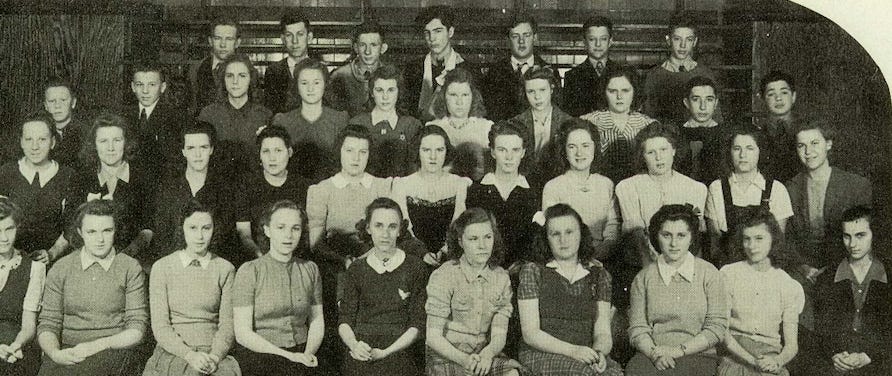
She learned two things at an early age: Men were largely unnecessary and you sometimes had to put up with them for certain things, but not always; and that secrets were part of daily life.
She decided that she never wanted to be saddled with her mother’s life – or her sister’s. All she wanted was a house of her own with no dirt floors.
Her ticket out was to snag a husband with a future, though it was hard to escape her mother’s opinions about men. But Jean was 20 years old, considered over the hill at a time when most girls were betrothed by eleventh grade. When she met Louis, who wanted to be a dentist, she thought she hit the jackpot. She [probably] didn’t love him, but to her, that didn’t matter: he grew up in a house with a real basement.
Louis, my father, was a first-generation Polish-American who had lost half his teeth as a kid. When he was 17, he lied about his age to enlist in the Navy after Pearl Harbor because he knew they’d give him teeth. He spent two years as a medic in the Pacific during World War Two and treated hundreds of casualties, not always successfully. A sniper’s bullet found him when he was only 19. Who knows how many soldiers died because there was one less medic out in the field.
But also: An eighth of an inch in either direction, and no me.
When they married in 1948, they were both happy to keep their pasts firmly in the rearview mirror. Jean worked as a secretary while Louis attended college and then dental school. At his graduation, the University of Pennsylvania gave her a wooden plaque with PhT – Putting Hubby Through – etched onto tarnished brass. They moved to a leafy New Jersey suburb known for its well-kept houses with no dirt floors and great schools.
Not that she cared about the schools. After twelve years of marriage and no pregnancy — at least not one that stuck — she thought she was home free especially when a routine visit to her doctor revealed tumors on both ovaries, one the size of a grapefruit.
“Take them out,” she said. Crashing into the hormonal brick wall of sudden menopause was a thousand times better than having motherhood darken her door.
But her male doctor only removed 1-1/2 of them. Women had little say over their bodies in those dark days.
Some would say things haven’t changed all that much.
In contrast, my father viewed fatherhood as his salvation, a way to focus outward instead of turning inward on his festering postwar trauma. After years of barrenness — with no clue who was at fault — he pulled his beige 1960 VW Beetle out of the garage one morning and said, “Let’s take a drive into the city, Jeannie.”
They headed out for what started out as a pleasant ride into Manhattan but which ended very differently when Jane, a 16-month-old red-haired chatterbox, came home with them.
In 1960s patriarchy, a husband’s permission was enough to adopt a child. No home visits, no vetting.
And no wife’s signature required.
The toddler had already been abandoned several times, first by her 35-year-old birth mother, and then by a series of foster families. This time, however, she couldn’t understand why she was wrenched away yet again and handed over to two strangers who were calling her Jane. But her name was Patricia Anne. From that first day — actually, for her entire life — the girl railed against her displacement with almost-daily tantrums and wrestling matches.
This is not what my mother had signed up for. She tried to give Jane back to the adoption agency. Twice.
When that didn’t work — see above, 1960s patriarchy — she turned against her husband, at least most of the time. Because that half-ovary wasn’t quite ready to give up the ghost.
I was born 18 months later.
If that doctor had listened to her, then no me.
At first, my mother went through the motions of mid-1960s nuclear familyhood. Every year she scheduled sessions at a local photo studio for obligatory gauzy childhood pictures taken by photographers in polyester pants with breath that smelled like turpentine. She channeled her rage into ironing knife-edged pleats into our lace-edged satin dresses late into the night before a shoot.
The photos weren’t airbrushed, but we always came out looking fake anyway. It was the only time all year that my sister and I stood within inches of each other.
Eventually, my mother gave up the pretense. She moved out of their bedroom and into the den, sleeping on the sofa and taking all of her meals in front of the 20-inch color Magnavox. She communicated with her husband only when absolutely necessary, leaving scrawled notes on the recently-purchased butter-colored kitchen table that seated only three.
This is not what my father had signed up for. All he wanted was a family of his own, and instead he got a tangled ball of frustration in his wife’s rejection and his adopted daughter’s endless rage. Forced to bury yet another trauma, he turned elsewhere, to drink and female company.
I created no such angst. I was the quiet one, the good little girl who learned early on to make herself as small as possible so her parents wouldn’t hate her, too.
I withdrew to my room, my own small space, where I was in control.
Just like my mother one floor below in her den.
After the divorce in 1974 — and my father’s death by suicide eight months later — my mother finally gave up all pretense when it came to motherhood. At Christmas dinner that year, she refused to make pierogies — practically a Polish birthright — and as our traumatized skeleton family sat around the table, her half-sister, the one who had helped turn her off to motherhood forever, announced there was no point in saying grace.
“There’s nothing to be thankful for,” said Aunt Gladys.
In the aftermath, I completely shut down. I was used to having no one to talk to, and spent most of my time in my room. When The Boy in the Plastic Bubble came out two years later, a TV movie starring John Travolta in his first starring role, it occurred to me that I had created my own plastic bubble, and while Travolta’s character wanted to change his situation, I didn’t. I was fine with not letting anything in, or out for that matter.
It took decades for the bubble to start to disintegrate.
* * *
In retrospect, this piece is not so much a What If? but rather a variation on the theme about decisions made and the cascading reactions to those decisions, ad infinitum, until a family disintegrates under its own weight of crossed wires and thwarted desires.
This Week’s Takeaway: It’s a curious exercise to trace your roots backwards. While it allows you to see the cause and effect of a tiny action, it’s also a great tool for developing empathy towards others, especially these days when empathy is in danger of becoming extinct.
That school photo is haunting. Did you notice, too, that she's the only one in the photo not looking at the camera, the opposite of what's happening in that famous tennis court scene in Hitchcock's "Strangers on a Train"? There's something very telling about her avoidance of the camera, which I read as a hope that if I don't see it, it can't see me and I won't really exist in the public world that that camera represents. I can't help wondering what sort of parallelism there might be between your mother's avoidance/denial of the other's gaze in that photo, and your avoidance/past denial of your childhood traumas in your history as a researcher and writer, a wish not to exist in the eyes of some oppressive other whose expectations are unwanted obligations or prisons of some sort. The avoidance of the other's gaze seems less an effort to deny the other's existence than an attempt to escape the other's inspection, through which your public face could be revealed as a false front.
The what if game got the ball rolling here....loved what you've written as to their backstories and how you slid into your own bubble and point out the fact it was right above your mother in the den.